
How we used phylogenetics to disentangle the complex relationships between 14 Bifidobacterium species
Everyone in the microbiome industry knows Bifidobacterium. It is the poster child of probiotics, a key marker of infant health, and a dominant player in the gut.
But for manufacturers and product developers, Bifidobacterium is a headache.
The genus is a “crowded room.” Species are closely related, and traditional identification methods often struggle to distinguish them. We call this the “Bifido Blur.” Common molecular methods (like 16S rRNA gene sequencing) often lack the resolution to tell the difference between important commercial strains, while plating protocols can struggle to selectively grow specific subspecies.
At Branchpoint, “blur” isn’t good enough. To design the most accurate qPCR assays, we start by mapping the room.
Step 1: Mining the Map (Phylogenetics)
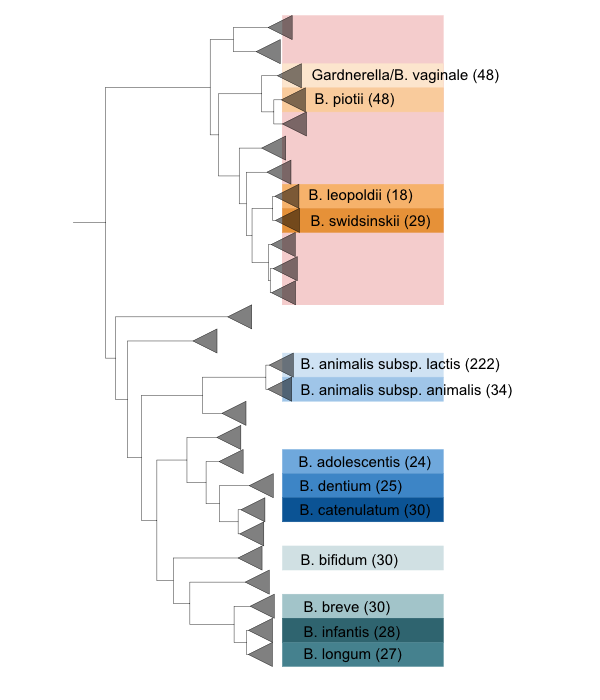
Our assay design process doesn’t start with primers; it starts with data mining. We leverage proprietary pipelines to mine global databases, analyzing thousands of genomes to understand exactly how microbial species are related.
When we looked at Bifidobacterium, we found two distinct, high-value clusters (See Figure 1).
1. The B. vaginale Complex (Red/Orange) Historically known as Gardnerella vaginalis, this group is critical for women’s health. It is often linked to dysbiosis in the vaginal microbiome. However, recent genomic work (confirmed by our internal analysis) reveals this isn’t one species – it’s a complex of multiple distinct species like B. piotii, B. leopoldii, and B. swidsinskii. Each likely has unique gene content and physiological impacts on health, making specific detection vital for next-gen therapeutics.
2. The Probiotic Complex (Blue) Right next door are the commercial heavyweights: B. longum, B. breve, B. infantis, and B. animalis. The challenge here is splitting “subspecies.”
- The Animalis Split: B. animalis subsp. lactis is the most common commercial probiotic. B. animalis subsp. animalis is often naturally occurring. Distinguishing them is notoriously difficult.
- The Longum Split: B. longum subsp. infantis is a high-value infant probiotic. B. longum subsp. longum is ubiquitous in adults.
Defining these groups at a fine phylogenetic scale is the only way to create inputs for our qPCR prediction pipeline.
Step 2: The Specificity “Cage Match”
Once we defined the groups, we used our prediction pipeline – which boasts an incredibly high in vitro success rate – to design assays targeting 14 specific species and “subspecies”.
Then, we stress-tested them.
We established a “Cage Match” experiment: 14 Branchpoint Assays vs. 11 Genomic DNA Targets (plus 3 synthetic amplicons). This included DSMZ type strains and synthetic controls for B. vaginale groups without isolates.
The goal? Perfect diagonals. We wanted to see strong Cq values (amplification) where the assay matched the target, and absolute silence (no amplification) everywhere else.
|
Branchpoint qPCR Assays ↓ |
Source DNA (Type Strains & Synthetic Controls) | |||||||||||||
|---|---|---|---|---|---|---|---|---|---|---|---|---|---|---|
B. dentium |
B. animalis |
B. lactis |
B. breve |
B. infantis |
B. pseudocat. |
B. adolesc. |
B. longum |
B. bifidum |
B. catenulatum |
B. vaginale |
B. leopoldii |
B. piotii |
B. swidsinskii |
|
| DSM 20436 |
DSM 26074 |
DSM 10140 |
DSM 20213 |
DSM 20088 |
DSM 20438 |
DSM 20087 |
DSM 20219 |
DSM 20456 |
DSM 16992 |
DSM 4944 |
gb0035 (Synth) |
gb0030 (Synth) |
gb0036 (Synth) |
|
| B. dentium ASY0336 | 20.32 | – | – | – | – | – | – | – | – | – | – | – | – | – |
| B. animalis ASY0570 | – | 23.65 | – | – | – | – | – | – | – | – | – | – | – | – |
| B. lactis ASY0569 | – | – | 18.09 | – | – | – | – | – | – | – | – | – | – | – |
| B. breve ASY0568 | – | – | – | 21.62 | – | – | – | – | – | – | – | – | – | – |
| B. infantis ASY0053 | – | – | – | – | 24.52 | – | – | – | – | – | – | – | – | – |
| B. pseudocat. ASY0163 | – | – | – | – | – | 21.79 | – | – | – | – | – | – | – | – |
| B. adolesc. ASY0052 | – | – | – | – | – | – | 22.32 | – | – | – | – | – | – | – |
| B. longum ASY0571 | – | – | – | – | – | – | – | 20.87 | – | – | – | – | – | – |
| B. bifidum ASY0567 | – | – | – | – | – | – | – | – | 18.55 | – | – | – | – | – |
| B. caten. ASY0201 | – | – | – | – | – | – | – | – | – | 17.16 | – | – | – | – |
| B. vaginale ASY0202 | – | – | – | – | – | – | – | – | – | – | 19.23 | – | – | – |
| B. leopoldii ASY0182 | – | – | – | – | – | – | – | – | – | – | – | 20.33 | – | – |
| B. piotii ASY0183 | – | – | – | – | – | – | – | – | – | – | – | – | 18.71 | – |
| B. swidsinskii ASY0186 | – | – | – | – | – | – | – | – | – | – | – | – | – | 15.03 |
The Results
As the data shows, the “Bifido Blur” is gone.
- Subspecies Resolved: Our B. lactis assay (ASY0569) hit its target (Cq 18.09) but completely ignored the closely related B. animalis.
- Infantis Identified: The B. infantis assay (ASY0053) picked up the infant-associated subspecies (Cq 24.52) without cross-reacting with adult B. longum.
- The Vaginale Complex: We successfully distinguished B. piotii (Cq 18.71) from the type strain G. vaginalis.
Why This Matters
This data confirms that Branchpoint’s approach – deep phylogenetic mining paired with robust validation – works. We have an established validation pipeline that screens assays against the genomic DNA of 250+ organisms, and it is constantly growing.
Whether you are verifying a raw material, tracking a specific strain in a clinical trial, or ensuring your “infant” probiotic doesn’t contain adult strains, you need a ruler that measures exactly what you think it measures.
Ready to clear up the blur in your pipeline? We are opening up slots for 3 Pilot Projects next month. What is your “problem strain?” The one plating or sequencing struggles with – and let us demonstrate the difference of best in class qPCR assays.