
How we used qPCR to stress-test a “10 Billion AFU” Akkermansia supplement
In October, while attending a global supply conference, I stopped by a booth providing samples of their Akkermansia probiotic.
Clearly advertised on the bottle was a bold statement: “10 BILLION AFU/cap.”
Naturally, I took a bottle home with a single thought in mind: Let’s see how accurate this claim really is using our own technology.
The Alphabet Soup of Enumeration
Enumeration is critical in probiotic manufacturing. As the International Probiotic Association states: “Dosages commonly range from 1 billion to over 100 billion [units]… The effective dose should at least be the dose that is documented to confer the desired health or physiological benefit.”
However, not all counting methods are created equal. This particular manufacturer wasn’t using the industry-standard CFU (Colony Forming Units), which measures how many cells grow on a plate. Instead, they used AFU (Active Fluorescent Units).
To understand the difference, we have to look at the three main physical counting methods:
- CFU (Colony Forming Units): Measures cells that can replicate on growth media.
- AFU (Active Fluorescent Units): Uses flow cytometry to count metabolically active cells.
- TFU (Total Fluorescent Units): Counts all cells, alive or dead.
The Branchpoint Approach: Molecular Enumeration
At Branchpoint, we take a different route. We leverage qPCR molecular assays to enumerate the probiotic contents of the capsule. For this test, we used our custom-designed Akkermansia muciniphila qPCR assay. This assay targets the species level, capturing all strains within the species. We screened for unexpected contaminants, including four assays targeting closely related species. We do this because Akkermansia has been split into multiple species recently and these related species may love similar growth conditions and be difficult to detect in small numbers, especially when using AFU enumeration (we address this in another of our blog posts here). We also searched for common spore-forming microbes which can be persistent in manufacturing facilities.
The Protocol
- We created a standard curve using genomic DNA from the A. muciniphila type strain (DSM 26127). This allows us to directly translate a Cq value into copy numbers.
- The probiotic contents were resuspended, diluted, and extracted using a DNA extraction kit.
- We performed the qPCR.
The Results: 10 Billion vs. 30 Billion
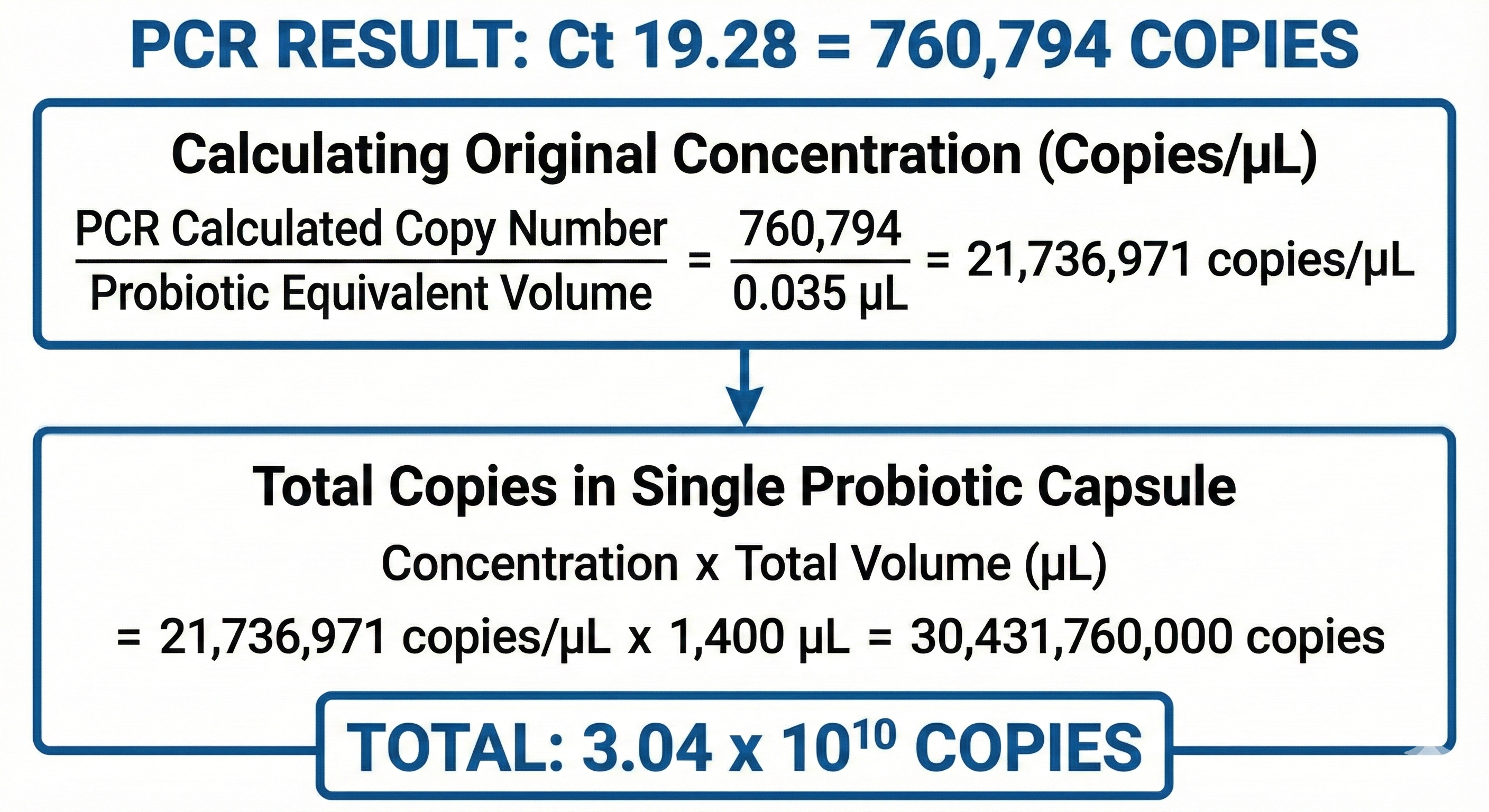
The qPCR returned a Cq value of 19.28. Based on our standard curve, this correlates to 760,794 copies in the reaction. When we apply the dilution factors used during extraction, the math reveals the total content of the capsule:

Additionally, our contamination screen came back clean. No other tested bacteria were detected.
Why the Difference?
The label claims 10 billion AFU, but we detected 30 billion genomes. Is the label wrong? Not necessarily. We consider this to be a validation of an accurate product for three key reasons:
- Shelf-Life Stability: Best practices dictate that labels reflect the viable cell count at the end of the product’s shelf life. Manufacturers often “overfill” at the time of packaging to guarantee that 10 billion active cells remain after 12-24 months.
- Genome Copy Number: Most active bacterial cells contain multiple copies of their genome. A single “Active Fluorescent Unit” (cell) might contain two or more genome copies, which qPCR will detect.
- Methodology: We are comparing metabolic activity (AFU) to genetic presence (qPCR).
Species vs. Strain
At Branchpoint, we love working at the SPECIES level for assays like this because it allows us to validate almost any A. muciniphila strain on the market. However, we are also experts at STRAIN level qPCR, capable of developing assays specific down to a single nucleotide polymorphism.
Whether you need to verify a raw material supplier or validate your finished product, molecular methods offer a speed and precision that plating simply can’t match.
Excited to make molecular methods part of your workflow?