
A few months ago, a new customer, a research group we hadn’t worked with before, ordered a set of custom assays. They were braced for the usual “wet lab tax” – weeks of optimization, playing with annealing temperatures, and troubleshooting primer dimers.
Instead, they ran the assays, got clean data on the first try, and immediately sent us a note:
“I’ve never had a qPCR assay work so easily out of the box. How did you do it? Is it magic?”
That research group has since made several repeat purchases, and expanded their targets once they realized how easy the process could be.
I love getting that feedback, but I always have to tell them the same thing: It isn’t magic. It’s an industrial-grade design engine, rigorous validation, and a refusal to accept the industry status quo.
At Branchpoint Biosciences, our goal isn’t just to sell you an assay; it’s to give you the shortest path to high quality data. Here’s how we’re making “frictionless qPCR” a reality and not just in the human microbiome.
1. We Don’t Guess. We Predict.
The “magic” our customers feel is actually our proprietary bioinformatics pipeline. Most labs design primers by picking a gene and hoping for the best. We design by comprehensively assessing targets and screening against everything else. We brag about this all the time, but our in vitro testing success rate is over 85%.
We have recently integrated a new Machine Learning-based method into our pipeline to predict multiplexing success. This model has brought our predictive accuracy for multiplexing to near 100%. Before a single tube is mixed in the lab, we know exactly how those primers will behave in a complex soup of DNA.
This means when you open a Branchpoint assay kit, the R&D risk has already been engineered out.
2. We Did the Troubleshooting So You Don’t Have To.
Two of the biggest hidden costs in research are expensive reagents that don’t actually do what they claim, and the time it takes to learn that difficult reality.
Recently, we noticed something odd. Our assays were functioning with such high sensitivity that they started exposing flaws in the “premium” reagents we were using. We realized that standard “multiplex” master mixes are often designed for human genetics, where target genes exist at similar levels. However, they fail miserably in microbiome work, where one species might be millions of times more abundant than another.
We didn’t accept the industry standard. We benchmarked the few solutions on the market that claimed to maintain a Limit of Detection (LOD) over massive dynamic ranges.
The result? We found several mixes that actually work for complex microbial communities. It protects the signal of rare taxa even when dominant species are screaming in the background. The kicker? This superior mix is cheaper per reaction than our current option. When you work with us, you aren’t just buying an assay; you are buying the knowledge of which reagents actually work, saving you both time and money.
3. From Deep Sea Sediment to Deep Space
Our NIDCR-funded work on the oral microbiome is our flagship, but our platform’s versatility is taking us to the extremes of the planet and off it.
We have been tackling the most difficult samples imaginable. In the last year alone, we have:
- Designed Genus-level assays for notoriously complex groups like Bacillus.
- Built assays for deep-sea sediment, identifying microbes that live under crushing pressure.
- Created high-sensitivity tools for manufacturing facilities used to build missions bound for space.
These clients come to us because standard contamination checks aren’t enough when the stakes are literally “planetary protection.” Whether you are sampling the ocean floor or swabbing a spacecraft assembly room, we design assays that work in your specific environment.
4. The New Standard for Oral Health
While we expand into environmental testing, we are closing in on the finish line for our NIDCR-funded Oral Panel. We have now validated 306 assays for 1-to-1 targeting of key oral microbes, with only 10 remaining to be finalized.
Why does this matter? In our recent benchmarking, across three samples, we found 160 instances where our qPCR assays quantified a taxon that shotgun metagenomics missed. But the data reveals something even more critical about how we measure biology.
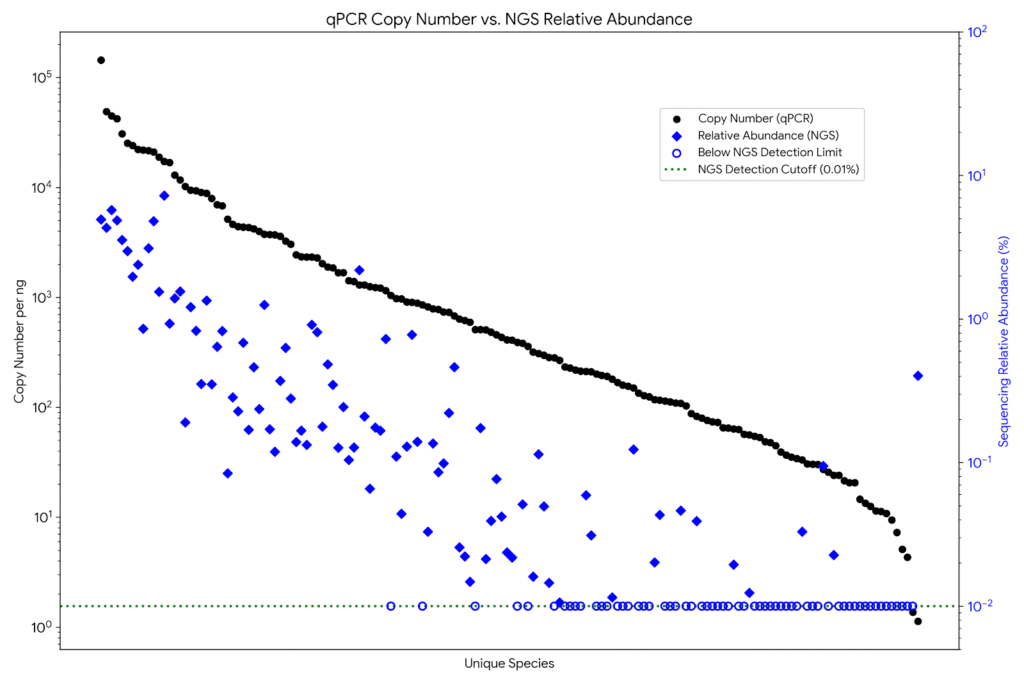
By sorting the data by absolute copy number, a clear pattern emerges. The qPCR data (black dots) tracks the declining microbial population in a smooth, consistent curve. In contrast, the NGS relative abundance (blue diamonds) is noisy and erratic. Even when sequencing detects a target, the “value” it gives you jumps around unpredictably, losing the fine-grain resolution that qPCR maintains down to the single copy. By using Branchpoint tools, you aren’t just getting more data; you are getting cleaner data that reflects the true order of the microbiome.
Stop Optimizing. Start Quantifying.
We know that many labs are still doing qPCR the hard way. Or haven’t considered qPCR in a few years because they’re wary of inherent difficulties. That’s why we’re here to help. We have a library of 435+ lab-validated assays ready to go. We also design custom solutions that work on the first run. And we are doing it at a price point that is significantly lower than our competitors. If you are tired of troubleshooting and ready to just run the experiment, let us know. We’ll handle the “magic” – you just handle the data.